Mirounga leonina, honoured guest

14 10 2009

The cup of tea could wait.

“We had a very special visitor this week,” said Rosalie, “Do you want to see if he’s still here?” Silly question! I grabbed my camera and we walked down to the headland.

With a wave hello...

With a wave hello...

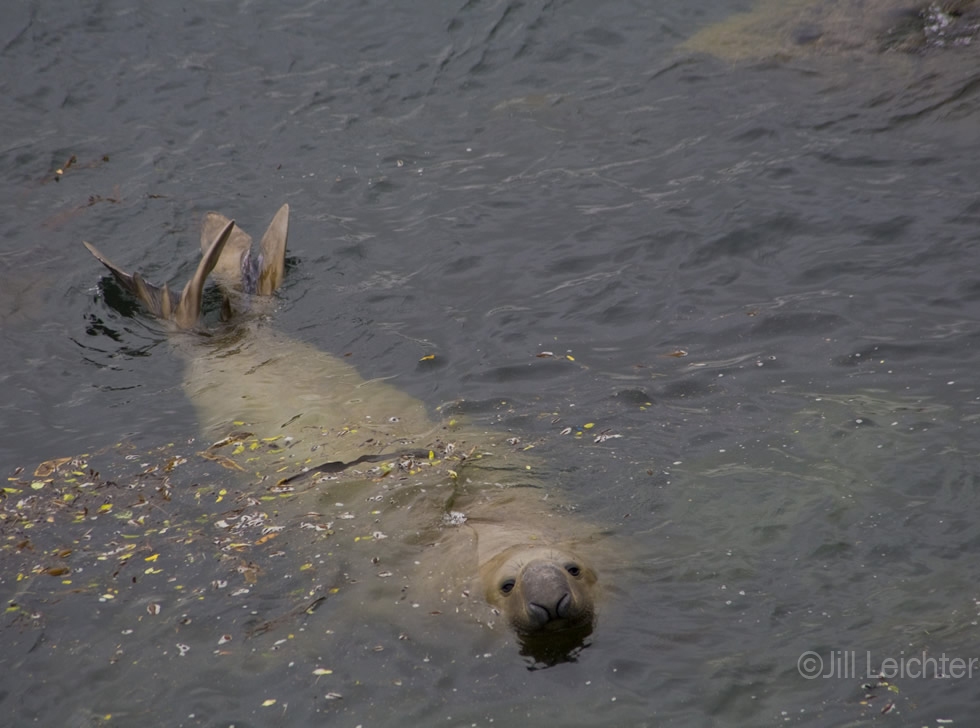
The gloomy skies hadn’t stopped the tourists and we met a British couple admiring the baby seals below the cliff. Rosalie leaned over a little further and smiled at the beautiful sleeping giant. The sight of him made us laugh out loud (in delight) and the elephant seal responded by opening his big black eyes to stare back at us. At the sound of our voices he heaved himself up and galumphed into the water. Shy but still curious, he stayed close to shore and watched us from the safety of his watery home.

More at home in the water. Best diver ever.

More at home in the water. Best diver ever.

Southern elephant seals are rare visitors to the South Island. They live in the southern Atlantic, Pacific and Indian Oceans that surround Antarctica. As the largest seals in the world, they can reach a whopping five metres in length.  They also have the biggest sexual dimorphism of any seal and perhaps any mammal: bull elephant seals can weigh as much as 4000 kilos. That’s ten times heavier than some females. They are amazing divers : after more than twenty minutes at 1400 metres, they only need two minutes at the surface to catch their breath before they dive again. And to think that this amazing seal’s body was built entirely by fish and squid. We are grateful, at Katiki Point, that penguins are not to his palette.

Although he had the beautiful tawny colour of a breeding male, he was only three metres long and even when he is ready, may not get much of a chance to mate, ever. That right is reserved for only 2-3% of the males who may mate with up to 100 females in a season. But this teenager is still a success story because 90% of male elephant seals die before they even reach breeding age.

Our visitor has yet to develop the nose that earned this seal its name, but this is what his face might look like when he is fully mature…not sure if it is scary or funny. I think both.

Here's looking at you...

Here's looking at you...


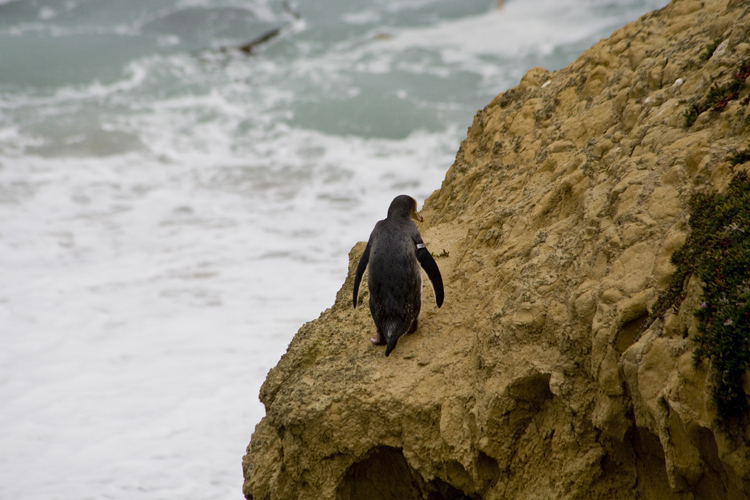
Where have all the penguins gone?

6 10 2009

At Katiki Point nest numbers are down. It is the first breeding season in seven years (since Rosalie took over the penguin hospital) that there are fewer nests than the year before. Rosalie, however, is looking at the glass as half full. There are 23 nests at Katiki Point, and 23 nests at Barracouta Bay (one more than last year), all together 46 pairs of yellow-eyed penguins sitting on eggs and hopefully able to raise up two big fat chicks. She is happy to see Diesel (the 20-year-old patriarch of the colony) and Lady Diesel have returned because every year that Diesel comes back is a bonus. Despite his age he is a dependable and successful breeder. Lady Diesel was in hospital for a very long stay last year, and seeing her on her nest is very satisfying.

My love has gone.

Perhaps she will come back today?

Glass half empty? Mostly females are missing, so their partners prepared beautiful nest bowls and then waited in vain for their return. They now face the breeding season alone. Normally, a suddenly-single male would find a juvenile female to replace his lost partner. Their first attempts at breeding might fail, but eventually they’d get it right. In a year or two the eggs would be fertile, their chicks would fledge and they would have a successful partnership. But this year, not one juvenile has returned to Katiki Point. At the best of times, juvenile mortality is about 70% (the first winter in the ocean is TOUGH) but this year it looks like we may have lost all of them.

Rats!

Rats!

The goal for the penguin hospital this season, however, is no different than any other season. Keep the birds as healthy as possible on land because we have no power over what is happening in the ocean. Let’s hope this summer the ocean will provide abundant fish exactly where the fish should be.


In memory of a Shy Mollymawk

4 10 2009

Even in death it was a beautiful bird. After a week of rain Sophie and I were glad to be out walking on the beach even it meant getting soaked. Zena the wonder dog also enjoyed it immensely. She snuffled the tangled piles of kelp and seaweed heaped on the sand, rusty coloured reminders of the hard wind earlier in the week. As we finished our walk,  I spotted a drowned albatross at the high tide line. Eye still intact, it had not been dead long.

Shy Mollymawk, Osborne Beach.

Shy Mollymawk, Osborne Beach.

Graeme at the Department of Conservation identified it as a Shy Mollymawk and thought it must have had a hard time in the strong winds. These birds are declining in alarming numbers, so DoC will be doing an autopsy to determine the cause of death.

Shy Albatross, Thalassarche cauta, New Zealand. Author: Mark Jobling

Shy Albatross (Mollymawk) in life. Photograph by Mark Jobling, Creative Commons. "I now belong to a higher cult of mortals – for I have seen the albatross." wrote Robert Cushman Murphy an American ornithologist in a letter to his wife in 1912.

Albatross and their Mollymawk cousins are amazing birds. They know how to catch every nuance of the wind and fly gracefully like a glider. Most of their life is spent on open ocean and visits to land are for breeding purposes only.

These days they must share the open ocean with fishing boats. Seabirds, including penguins, get caught and drown when they go for bait on long lines but real numbers of drownings are hard to come by because long term monitoring of bycatch is political and problematic. The word “bycatch” gives no indication of the horror of drowned seabirds, sea turtles, and sea mammals that are caught in fishing nets every day and dumped back into the ocean as waste.

In the past five years, the steep decline of seabird populations all over the world has made some people look for solutions to this part of the puzzle. A new bait cover for long lines that dissolves at depths greater than a seabird can dive will prevent their accidental drowning (although our yellow-eyed penguin dives right to the bottom of the ocean floor).  Read an interview with the inventor Hans Jusett (a former fisherman) and learn about his personal experience of “bycatch” at the abc Radio Australia website.

Now we inventive humans must turn our attention to solutions to climate change, so that ocean currents and the fish that use them will stay close enough to where they have always been. That way our penguins, who are creatures of habit and more tied to the land, will continue to be able to find their food.


Eggs, Experience, and Survival

26 09 2009

“How many eggs do penguins lay a day?”

Annabel (Year 1, Opoho School) asked that wonderful question a few months back. I love how children always go with what they know and work from there. Annabel’s experience with eggs is the chicken variety, and she knows a hen lays a lot of eggs. Not more than one a day, perhaps, but if her needs are met and she gets 13 to16 hours of light (and doesn’t go broody and sit on her eggs) she can lay an egg nearly every day. With a false sun (i.e., lightbulb) you can fool your hens into constant laying even during the darker months of winter.

Nesting box. Changing of the guard...Photo by Rosalie Goldsworthy.

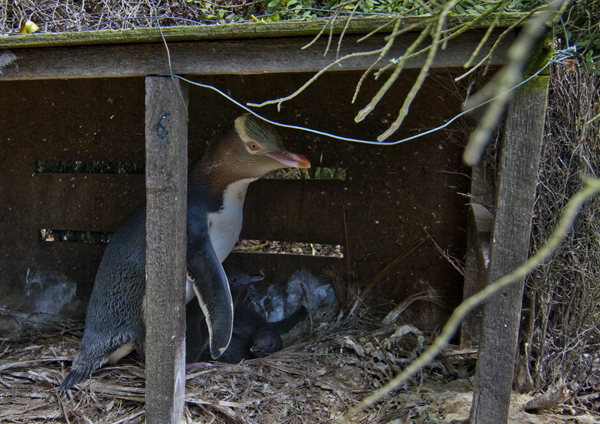
Changing of the guard...yellow-eyed penguin couple in a nest box at Katiki Point. Photo by Rosalie Goldsworthy.

Although the hours of light per day are important for penguins, it is more for knowing when it’s the right time to breed. Penguins do eggs differently than domesticated chickens that have been bred to lay lots of eggs. Unlike hens, penguins spend a huge amount of energy raising their chicks. Because raising chicks takes so much effort they only lay a few eggs per year. Our yellow-eyed penguins usually lay two eggs per year but some penguins lay two eggs and raise one chick (one egg is sacrificed), others lay one egg and raise one chick, and in warmer climates penguins may lay two eggs and raise two chicks. If food is plentiful for these subtropical penguins, they might lay another clutch to raise four chicks in a year. Still, as far as egg laying, penguins are nowhere near the chicken.

The key factor for fledgling survival with yellow-eyed and other penguins is parental experience. Experienced penguin parents who know how to find food, avoid predators, and return to the nest with enough food for their chicks, raise fatter chicks. And the fatter the chick, the better it fares when it goes out to sea for the first time. A few yellow-eyed penguin researchers have shared their thoughts on what they call the “super breeders” in a yellow-eyed penguin colony. These birds are the gold of the colony because they consistently raise two chicks successfully, well into old age. When you know your colony and run a penguin hospital, your super breeders are the birds that you take extra special care to see that they stay healthy. Both Hiltrun Ratz at Penguin Place and Rosalie Goldsworthy at Katiki Point do just that.


Birds, bees and Little Blue Penguins, guest post by Sophie Fern

18 09 2009

It has become a ritual in our house. We make tea, find biscuits and then it’s a mad rush to fit as many warm clothes as you can into a bag. Then, as the flask once again leaks warm milky tea all over everything, more warm clothes are found to replace the damp ones which are chucked towards the bathtub on the way out.

Our speed increases as we drive the twisting roads around Portobello Bay, watching the darkening sky on the horizon, scared that we’re going to be late. As the car climbs up the rocky cliffs at the beginning of Tairoa Heads, the person in the passenger seat starts to hold on just a little tighter as they look down at the sheer drop beside the car. But it’s like walking into the theatre after the lights have gone down. Socially unacceptable and you always feel that you have missed something crucial.

"Hey, have they gone yet?" Photo by Wayne Turner

"Hey, have they gone yet?" Photo by Wayne Turner

At the beginning of Tairoa Heads the driver slows down, as it is obvious now that we are in plenty of time. So much so that the first cup of tea can be drunk in the car as we enjoy the last few minutes of warmth before going out to face the elements. The beach has changed since I’ve been visiting. Now there are barriers and from October to May, a cheerful warden keeps people from startling the penguins. It’s August and tonight there are only seven of us there; a visitor and I, a family and a local who works as a warden in the summer.

With dusk falling quickly we stare out to sea, looking for the penguins rafting into the beach. Every ripple looks like a raft. I’ve only seen the rafting once, so it’s magical when a wave washes a penguin onto the beach. He stands there, looking dazed and shaking himself, as though he is as mystified as I am as to how he got there. The crowd whispers and small children, whose patience is wearing thin, are pushed to the front of the group so that they can be sure to see.

From the hills behind us the other penguins call. To their mates, or to the rest of the colony I don’t know. It’s as if they want to reassure the dazed looking penguins on the beach that yes, they are in the right place, and yes, there is a warm burrow to come back to, once they have run the gauntlet of humans who turn up every evening.

The family is getting cold, and it could well be after the children’s bedtime. They see three penguins and call it a night. The warden, my friend and I stay for another minute. Further along the beach the warden whispers to us in a loud birdwatchers whisper. He has a torch covered with a red filter, which the birds may not be able to see. He points out two animals in a hole to us. It is so dark I mistake a rock for a penguin.

“I didn’t see them,” I tell him.

“One last time,” he replies, and pans the beam to where the penguins have been.

And there they are, one on top of the other, doing what all good birds and bees do in the spring. We all laugh self consciously, and decide to leave them to mate in private. We want there to be lots of penguins for future generations to visit and that won’t happen if we hang around here just when a penguin needs some privacy.

This time we need our torches to light the way back up the hill, and check under the car for passing penguins. A second round of tea and biscuits is passed out and the passenger is given the ever leaking flask to clutch. The drive back is more leisurely as we talk penguins the whole way home.


Shy penguins and a “no go” zone

4 09 2009

Yellow-eyed penguins are not the only shy penguins on the planet. Before Ursula Ellenberg studied human disturbance in regard to our yellow-eyed penguins, she studied Humboldt penguins in Chile and found that they also have a problem with humans beings (see her article in Biological Conservation, 2006). It isn’t hard to imagine why. For 11,000 years, Chileans have hunted the penguins on the islands off the coast of Chile. This long term hunting pressure would have favoured the survival of birds that are more cautious and shy.

Who says we aren't social?

Who says we aren't social? This photo was taken from inside a hide a month ago (before they were nesting). I also took special care when entering and leaving the hide so as not to disturb them.


It is penguin nesting time again. And despite the fact that no juveniles have showed up yet at Katiki Point (yes they are very late), juveniles are not the best breeders. So we are hoping the older penguins will have a banner year and this means (as usual) we give them space when they are nesting.

For now, the breeding area is completely off limits for six to eight weeks so the yellow-eyed penguins can nest and lay their eggs in peace. That means no visits and a long wait till we see what they have been up to.


Man’s best friend is not a friend to penguins…

27 08 2009

Oh the smell of dogs! Not always pleasant, but through the funk there’s something friendly about it. Perhaps because there’s also a furry head resting on your knee with pleading eyes begging for a walk, a run, a breath of fresh air.

Xena and Anna on the southern end of Allan's Beach

Zena and Anna on the southern end of Allan's Beach. The beach north of the access track is restricted to dogs.

So you put your dog on a lead and go to feel the wind, smell the sea, and watch your dog run. The sand stretches before you as you throw a stick and let your dog off the lead.

But on the beaches of Otago DO BE CAREFUL WITH YOUR DOG! Many beaches and conservation areas are closed to dogs for good penguinish reasons. Unlike humans, dogs love all kinds of smells. And even though penguins smell like day-old fish to me (memorable, yes, but not in a good way), to dogs penguins smell absolutely delicious. On Otago Beaches in May, three yellow-eyed penguins were killed by dogs.

When penguins are moulting between March and May, they are especially vulnerable, but they are at risk for dog attacks year round. For a list of beaches and conservation areas closed to dogs see this page on the DCC website, but also check this page for the many places you CAN take your dog safely with and without a leash.

If you take your dog for a walk in a restricted area, you could be fined $300, and there are concerned citizens patrolling beaches on the peninsula. If your dog kills protected wildlife you could face further criminal charges: fines of up to $20,000 and/or imprisonment for up to three years.

Enjoy walking your dog on unrestricted beaches, but please keep your pet away from penguin breeding areas.


Let’s get this party started!

18 08 2009

Leave it to the shags to be the first to get dressed up for the spring fling. Their normally drab outfit has been replaced with a double crest of curling feathers, a bright turquoise eye patch, and a rich dark blue tail. They are ready to celebrate spring in full breeding-plumage style.

It's nearly spring, and spotted shags have already paired up on the Otago Coast

Spotted shags on the Otago Coast.

Last week, Wayne Turner guided me to a cliff near Katiki Point where the shags have already paired off and are busily making nests in every available nook and cranny. As we got closer, he warned that we might be harassed by red-billed gulls. We escaped their attention this time, but they’ve been known to screech such a loud warning that by the time you reach the cliff, the shags have all flown away.  The gulls scavenge leftover fish from the shags so by protecting them, they are simply protecting their food source.

This red algae will be perfect for my nest...

This red algae will be perfect for my nest...

In the old days this did not afford the shags enough protection as “sportsmen” would wait below a cliff and shoot for fun, destroying an entire colony in an afternoon. Thankfully those days are over and shag numbers have increased again to the point where if we approach quietly and carefully, we can enjoy shooting them with a camera.

As soon as the shags lay their eggs the party is OVER, and it’s back to their normal dull brown and grey feathers. But dull feathers serve a purpose too, as the shags will then blend in perfectly with the rocks of the cliff while they are incubating eggs and brooding chicks.


Penguins are particular

4 08 2009

Pilchards make penguins puke, or at least give them a serious tummy ache. This was one of the many things I learned at the yellow-eyed penguin symposium last weekend at the University of Otago.

Salmon defrosting for the evening meal

Salmon defrosting for the evening meal.

Bridey White, a wildlife technician from Massey University and the penguin keeper there, told us how high levels of histamines in this fish can cause stomach ulcers in birds, so it is not a recommended penguin food. The same goes for fish bait, because the added preservatives will kill a penguin. Oddly enough, even though penguins eat fresh fish in the ocean, frozen fish is better for them because freezing kills parasites. When a penguin is fighting for his life it’s better not to give them anything that might add to the burden of recovery.

Fat, healthy and happy.

Fat, healthy and happy. Photo by Wayne Turner.

A penguin is taken into the hospital when things are so bad the bird cannot feed itself any more. What we feed them in hospital is important because good nutrition promotes faster healing. A high calorie fish is required because penguins must have a good layer of fat to stay warm in the ocean.

Young salmon “fit the bill” perfectly. For many reasons they are the food of choice at the penguin hospital and luckily, penguins enjoy eating them. From the caretaker’s point of view, salmon have very accommodating gills that make it easy to insert medicine so the penguin will swallow pills without a fuss.

The way the salmon is prepared is key. Defrosting the fish in water is not recommended because as the fish warms up, the water will leach out most of the vitamins and minerals. Air defrosting is best, and when they are defrosted the fish should be firm to the touch, have clear eyes and a pleasant smell. After all, would you like to eat stinky old fish when you are used to ocean sushi? I think not!


Henry hesitates

28 07 2009

The very best thing about penguins is watching them come and go.

There's no place like home...

There's no place like home...

In the evening, several penguins arrive at once. I imagine them travelling home together on the sea highway from their office on the sea floor. When they pop up out of the ocean after a long day of fishing, they stand on the beach in the setting sun before leisurely making their way home. Their feather coats glow like pearls in the evening light.

In the morning, it is all rush rush rush. They run down to the beach in groups and with a great sense of purpose dive into the water one after the other…except for Henry. Henry hesitates. Henry puts one toe in the water and looks back at the beach to see if anyone else is coming. Henry, it seems, is not that fond of the ocean and he steps aside as penguins hop past him and dive into the waves. Henry turns himself around and with his back to the ocean and his head down, slowly walks back up the beach to land.

Henry, the ocean is behind you!

Henry, the ocean is behind you!

We are worried about Henry. He’s a juvenile but he’s not behaving like a fully fledged penguin. He is not overly thin so he must be fishing for food at some point during the day but it is odd to see a penguin turn away from the sea in the morning.

It’s a mystery, but Henry, we have our eye on you…we will give you one more stay in the hospital if you get too thin, but that will be your last chance. From that point on, it will be swim, or sink…